
What Is a Fractional Video Production Partner?
Your competitors are publishing professional video every single week. You're still waiting on a quote for your next project. What do your competitors know that you don't?
If you're still treating video like a once-in-a-while project — commissioning a shoot here, scrambling for a quote there — you already know the frustration. It's expensive every time. It takes forever to get started. You have to re-explain your brand from scratch. And by the time the final edit lands in your inbox, you’re exhausted and all your typical day-to-day work is now piled up.
There's a better model, and the businesses pulling ahead of you right now are already using it.
It's called a fractional video production partner. Once you understand how it works, the old way of doing video will never make sense again.
First, What Does "Fractional" Actually Mean?
The word fractional simply means you get access to a complete, professional capability — without needing to hire a full team on staff to deliver it.
You may have heard of a fractional CFO — a senior financial executive that growing businesses hire on a part-time basis instead of paying a full-time executive salary. They get CFO-level thinking and output at a fraction of the cost.
A fractional video production partner works exactly the same way.
Instead of hiring a full-time videographer, an editor, a content strategist, and a producer — and buying all the professional equipment that comes with them — you get access to all of that expertise and capability for a predictable monthly investment that fits your actual budget.
You get the advantage of having a whole team, at a fraction of the cost.
What's Wrong With the Old Way of Doing Things?
Most businesses are still approaching video the same way they'd approach a home renovation — they hire someone when they need something specific done, pay for it, and move on. It sounds reasonable but, for video marketing, this approach creates a pattern that quietly kills momentum.
Here's what it actually looks like in practice:
January — You decide you need a company overview video. You spend two weeks getting quotes, another week choosing a vendor, two weeks in pre-production, a shoot day, and three weeks of edits. You publish the video in late February.
February through May — You do nothing. Your channel goes quiet. Your audience forgets you exist.
June — You realize you need a testimonial video before a big trade show. The cycle starts over.
The result? You've spent significant money, burned enormous time, and produced a handful of videos that trickle out with no consistency. Meanwhile, your competitors — the ones publishing every single week — are building an audience, earning trust, and staying top-of-mind while you disappear between projects.
Modern marketing channels reward consistency above almost everything else. LinkedIn, YouTube, Instagram, and even your own website work better for brands that show up regularly than for brands that show up occasionally with something impressive.
The old model isn't just inefficient. It's quietly costing you market visibility every single month.
How a Fractional Video Production Partner Works
I get it — you didn't start your business to also become a part-time video producer, chasing vendors and managing shoot logistics on top of everything else you're already carrying.
That’s exactly the gap a fractional video partner is built to fill.
A fractional video production partner, like Scene2, operates as your ongoing, embedded video department. Here's what that looks like in practice:
Strategy — Before a single camera rolls, we figure out what videos will actually move the needle for your business. What does your audience need to see? What questions are your prospects asking before they buy? What content will build trust, drive leads, and keep your brand visible? This is strategic thinking — not just filming.
Production — Every month, we plan, script, shoot, direct, and edit your video content from start to finish. You don't manage vendors, chase timelines, or coordinate logistics. You will need to provide some input and approval, then we handle the rest.
Delivery — Polished, professional content lands in your hands on schedule, optimized for every platform your audience lives on — Instagram, LinkedIn, Facebook, YouTube, and TikTok — in every format each platform requires.
Consistency — Month after month, your brand shows up. Your audience grows. Your competitors stop gaining ground.
However big your team is, this fits. Maybe you already have someone managing your content calendar — a Social Media Manager or Communications Specialist who plans posts, handles engagement, and keeps your channels active. Great: a fractional video partner becomes their production department, handling the strategy, filming, and editing they don't have the time or specialized skill set to do themselves.
Or maybe you're a smaller, founder-led business with no one internally handling content yet. In that case, we become your entire video department from day one — planning, producing, and publishing consistent content without you hiring anyone at all.
You’ll feel relieved knowing you have a partner who knows your business, knows your audience, and shows up every month ready to execute.
You won’t have to re-explain your brand every time you need a video, AND you’ll be receiving strategic content at a reduced price!
The Real Cost Comparison: Attempting to Do Things In-House vs. Working with a Fractional Video Partner
In an effort to try to show up more consistently, some businesses try to increase their in-house capabilities without realizing all the hidden costs. This is where most businesses have their "why didn't anyone tell me this sooner" moment. I’ve seen the expression on people’s faces multiple times when I’ve shown this to them.
Let's look at what it costs to hire another employee vs. hiring a fractional video partner.
Option 1: Hire a Full-Time Employee
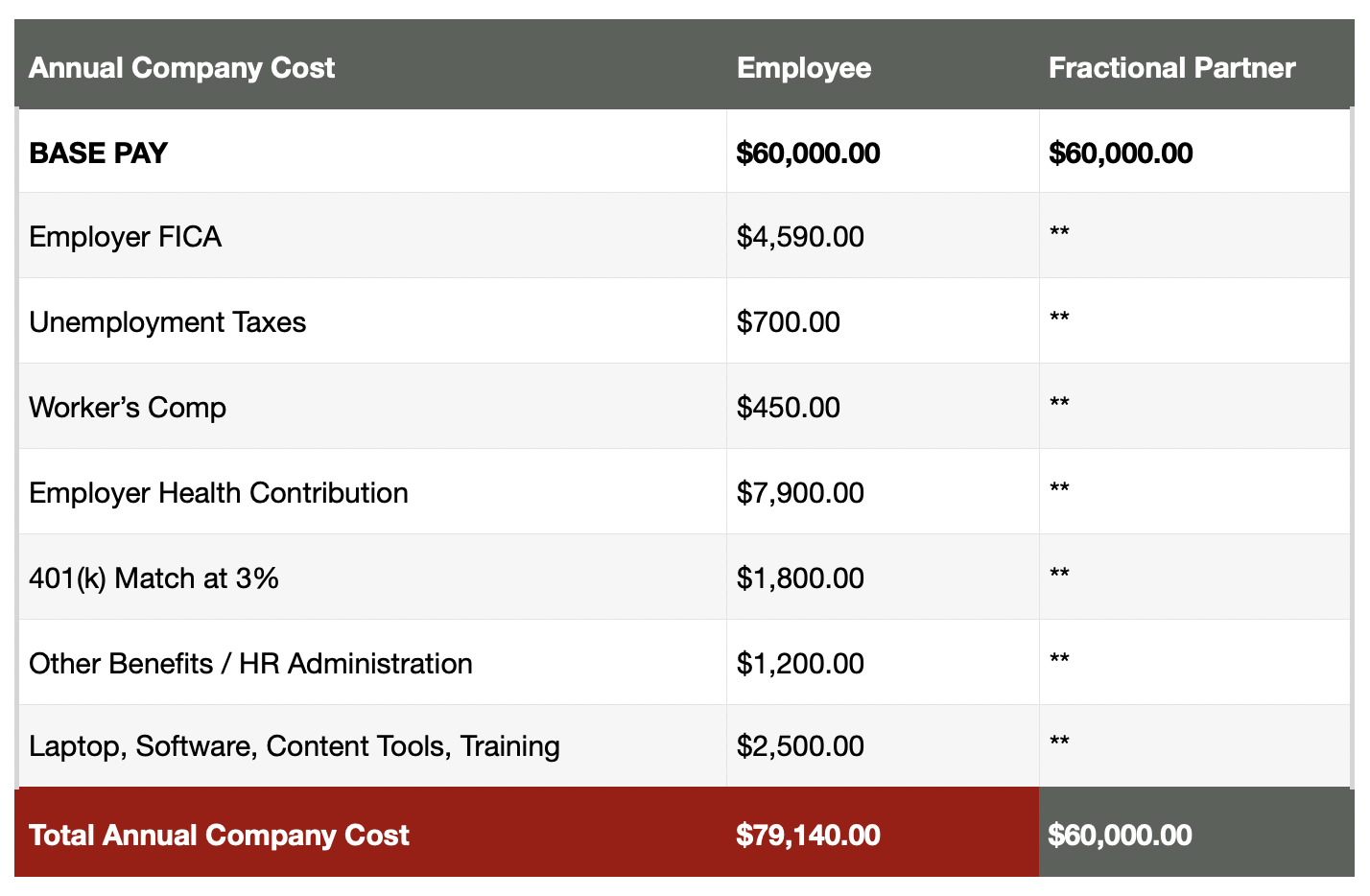
It seems like the logical solution — just hire someone. But the true cost of a full-time employee goes far beyond the salary line. And that's assuming one person can do everything — strategize, produce, shoot, and edit consistently at a professional level.
In reality, most in-house hires can handle some of these responsibilities well, but rarely all of them.
Estimated annual spend based on a $60,000 base salary: $79,140.00
(For one employee with limited scope and full hiring risk)
Option 2: Scene2 Fractional Video Partnership
Experience the peace that comes from having a complete video department on your team, including senior-level management, highly skilled and experienced crew, professional camera, sound, drone, and lighting equipment — strategy included — for LESS than the cost of hiring one employee.
This is what a Scene2 monthly video partnership can deliver:
☑️ Monthly content strategy call — we work with you and your internal team to figure out what to make and why
☑️ Short-form social videos — customized for your target audience
☑️ Long-form brand or testimonial videos
☑️ Full platform optimization — every video cut and formatted for every channel
☑️ Complete production management — scripting, shooting, directing, editing, delivery
Monthly investment (in this example): $5,000/month
Annual investment: $60,000
Note: We offer a lot of other options and can package things to meet your specific video and budget needs. This is just one example.
Let’s Talk about What This Looks Like for You
Whether you already have someone on your team managing content, or you're starting from scratch, a fractional video partnership gives you a full production department without the hiring risk, the equipment costs, or the management load.
Schedule a call, and let me show you what a fractional video partnership could look like for your business.
